


Coastal specific elevation models
Elevation models with high-resolution buildings of the Catalan coast
The ICGC offers the Digital Terrain Model with buildings (DTMe), covering the coastal strip up to 500 meters from the shoreline with a 50 cm resolution. It is generated from LiDAR flights, with georeferenced, classified, and validated point clouds, selecting terrain and building classes to combine topography and constructions.
Since 2022, two flights have been conducted annually, with additional flights after storms, ensuring constant updates. The product is complemented by historical data from 2008, creating an extensive time series for analyzing trends and validating predictive models.

| Geoinformation from the Cartographic and Geological Institute of Catalonia subject to a Creative Commons Attribution 4.0 International license (CC BY 4.0). More information |
Last update
- Publication date: March 2026.
- Data period: 2014, 2015, 2016, 2017, 2022, 2023 and 2024.
- Version: v1.0.
Description
The ICGC offers the Digital Terrain Model with buildings (DTMe), a high-precision product covering the Catalan coastline up to 500 meters from the shoreline, with a resolution of 50 cm in models from 2021 onwards and 1 m in historical models. This model is generated from LiDAR flights specific to the coastal area, providing a georeferenced and classified point cloud to differentiate terrain, buildings, vegetation, and water.
Once the georeferencing and classification of the point cloud is complete, and after applying quality control (QC) to validate the correct class assignment, the model is generated. For the DTM, the terrain and buildings classes are selected, combining natural topography with the representation of built elements. This process guarantees a detailed and realistic view of the coastline that reflects both the terrain morphology and the presence of infrastructure.
This information is essential for impact analysis, strategic planning, and vulnerability studies, as it allows for understanding the relationship between the terrain and buildings in coastal environments. Since 2022, two annual LiDAR flights (winter and autumn) have been conducted, with additional flights following storms, ensuring constant updates that provide significant value for monitoring changes, risk management, and scientific research.
Furthermore, this product is complemented by historical LiDAR flights conducted since 2008, which are also being processed to generate elevation models. This information provides an extensive time series, essential for analyzing long-term trends, comparing coastline evolution, and validating predictive models with real-world data accumulated over more than a decade.
Main technical characteristics
- MDTe product: Accurate representation of the topography of the buildings.
- Coverage: Coastal strip of Catalonia fins 500 m from the coastline.
- Data source: Nuvol of LiDAR points captured in periodic volumes on the coast of Catalonia.
- Resolution: 0.5m pixel in models starting in 2021 and 1m pixel in historical models.
- Reference system: EPSG: 25831.
- Format: GeoTIFF (raster). Null values: -9999.
- Update: Two seasons (winter and late afternoon) are more specific for coastal storms, more historical details.
Use cases
Urban flood simulation and vulnerability analysis
A DTMe is essential to model the behavior of the water in coastal urban environments, since it incorporates buildings that condition the flow. This allows:
- Simulate realistic flood scenarios in urban areas, including complete physical barriers.
- Identify critical points on water that can accumulate for the purpose of construction.
- Plan adaptation measures with drains, containment walls or rearrangement of spaces.
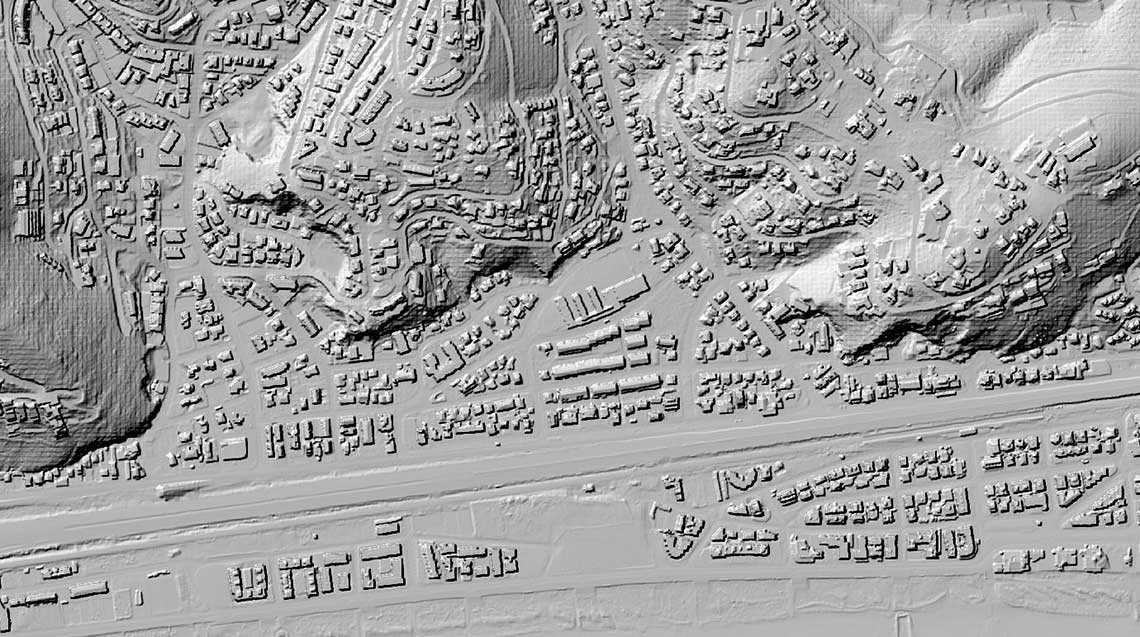
DTMe exploitation of the winter coast 2024 (Castelldefels Urbanization).
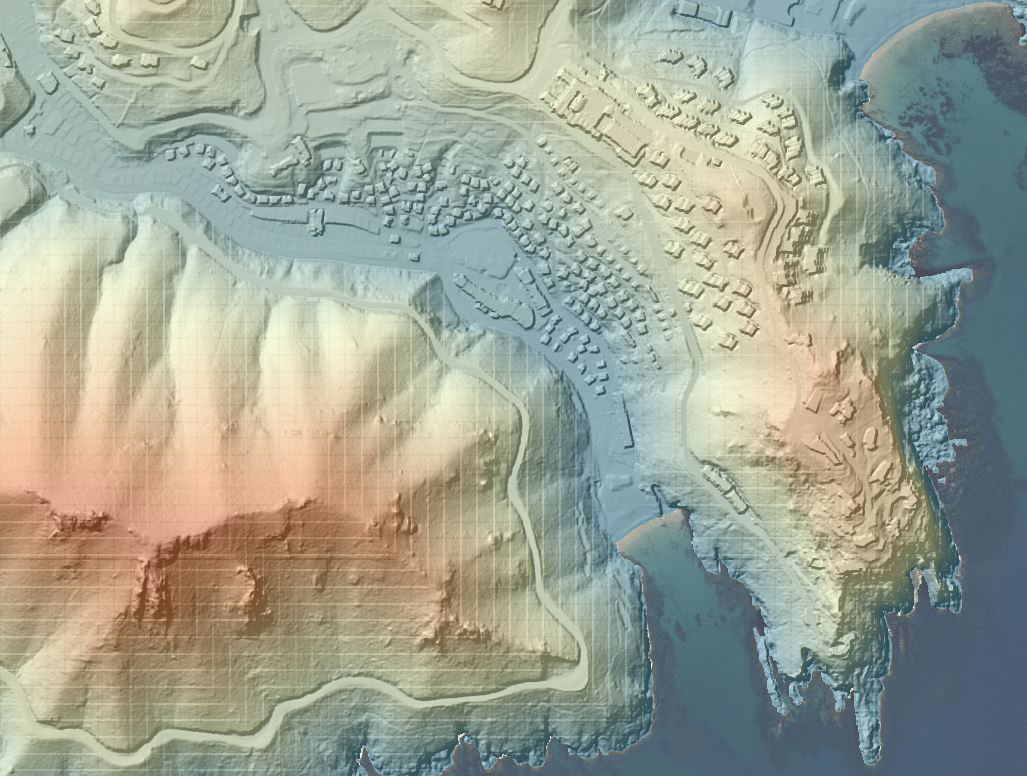
DTMe exploitation of the winter coast 2024 in Cala Pola (Tossa de Mar).
Planning of infrastructures and management of coastal areas
Using a DTMe is essential to be able to analyze the impact of new structures (ports, sea passages, roads) on the topography and coastal dynamics.
Also to study the interaction between land and existing buildings and optimize the location of equipment.
It can be used to simulate climate change scenarios with the presence of infrastructure, to define protection strategies.
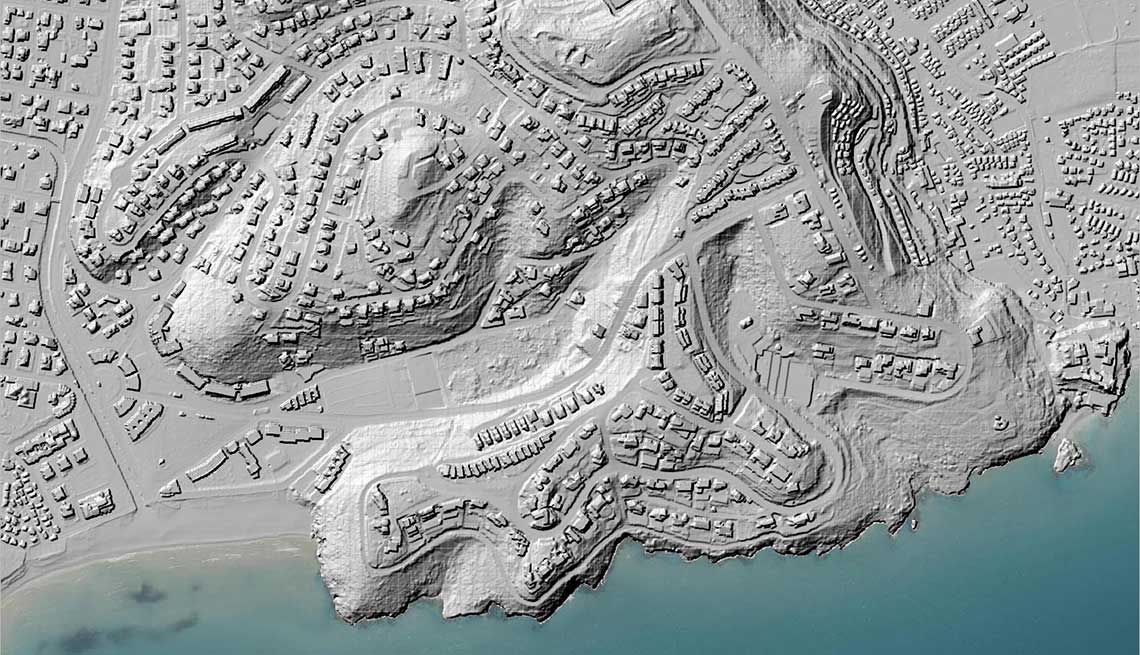
DTMe Coast Winter 2024 Cala Mora (Tarragonès).
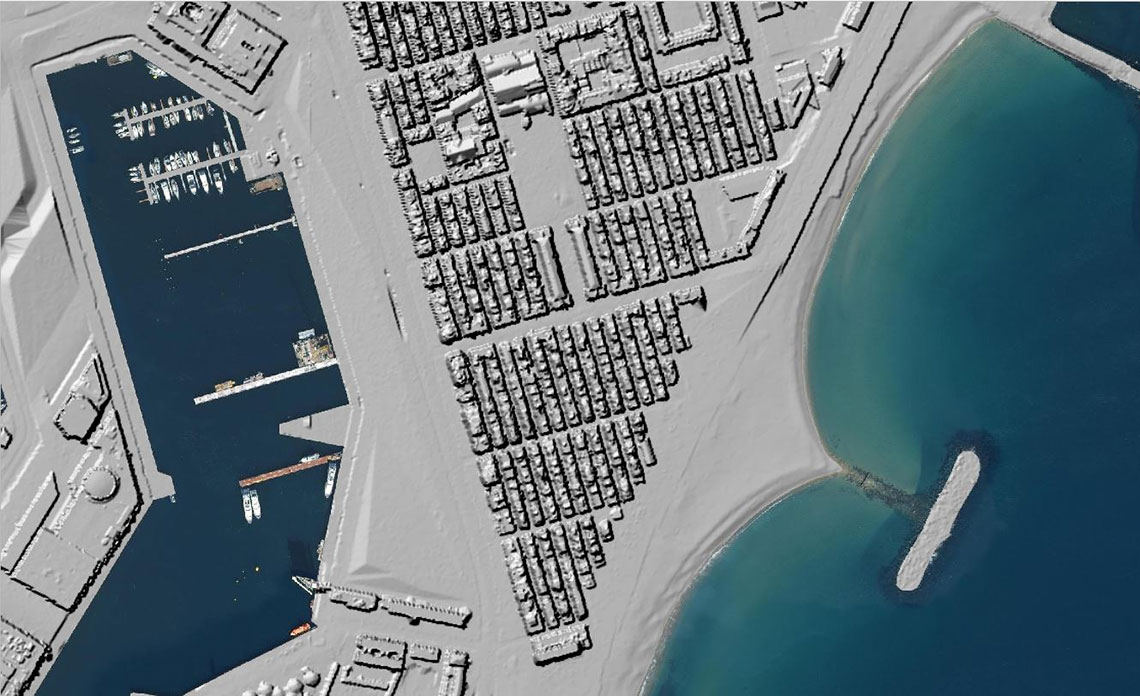
MDTe and DSMe Barceloneta exploitation.