



Urban Digital Twin of Catalonia
Explore Catalonia with the 3DCarrers viewer, measure and analyze urban areas
The Urban Digital Twin of Catalonia is an accurate and immersive representation of the urban areas of Catalonia, created from high-resolution LiDAR point clouds and panoramic images captured with Mobile Mapping technology. This resource provides a realistic three-dimensional model that facilitates urban planning, infrastructure management and territorial analysis..
Using the 3DCarrers Viewer, any user can freely consult the captured images. Authorized users have access to the LiDAR point cloud, with advanced functionalities such as taking measurements (building heights, sidewalk widths), locating elements and detailed visualization of the environment. This tool is ideal for administrations, engineers, architects and companies that need reliable information for decision-making.
With continuous updating, new Mobile Mapping data of urban centers is captured every year to be completed based on territorial dynamics and with the ultimate goal of covering the entire territory in a period of four years. This ensures that the information remains up-to-date and is progressively expanded, offering a dynamic and constantly evolving database.

| Geoinformation from the Cartographic and Geological Institute of Catalonia subject to a Creative Commons Attribution 4.0 International license (CC BY 4.0). More information. |
Last updated
- Publication date: 2023-2025.
- Information date: 2018-2025.
- Version: v1.1.
Description
The digital twin of the territory is a precise and immersive representation of the urban areas of Catalonia, created from high-resolution LiDAR data and images captured with Mobile Mapping technology. This resource provides a realistic three-dimensional model that facilitates urban planning, infrastructure management and territorial analysis.
Using the 3DCarrers viewer, any user can freely consult the captured images. Authorized users have access to the LiDAR point cloud, with advanced functionalities such as taking measurements (building heights, sidewalk widths), locating elements and detailed visualization of the environment. This tool is ideal for administrations, engineers, architects and companies that need reliable information for decision-making. In addition, new mobile mapping data of urban centers is captured every year with the aim of covering the entire territory in an approximate period of four years. This ensures that the information is kept up to date and progressively expanded, offering a dynamic and constantly evolving database.
The process to obtain this 3D model is rigorous and consists of several phases:
- Data capture: Panoramic images and LiDAR data are obtained using high-precision Mobile Mapping systems that travel through urban areas.
- Georeferencing and processing: The data is georeferenced to ensure its correct location in the official coordinate system and is processed to generate a coherent point cloud and optimized images.
- Geometric and visual quality control: Before publication, an exhaustive control is carried out to ensure geometric accuracy and visual quality, guaranteeing that the information is reliable for technical uses.
- Publication in the 3DCarrers viewer: The validated data is uploaded to the servers and published in the viewer, where the images can be freely consulted and, for authorized users, access to the point cloud with advanced tools.
- Periodic update: The project is developed with a four-year cycle to cover the entire territory, with annual captures that progressively expand the database.
Main technical characteristics
- High-resolution LiDAR data: Point clouds with centimeter precision.
- 360° panoramic images: Captured with Mobile Mapping technology.
- 3DCarrers Viewer: Free consultation of urban images.
- Restricted access to LiDAR data for authorized users.
- Advanced functions: taking measurements, location of elements, analysis of environments.
- Coverage: Urban areas of Catalonia.
- Compatibility: Integration with GIS systems and standard formats.
Use Cases
Urban Planning and Infrastructure Management
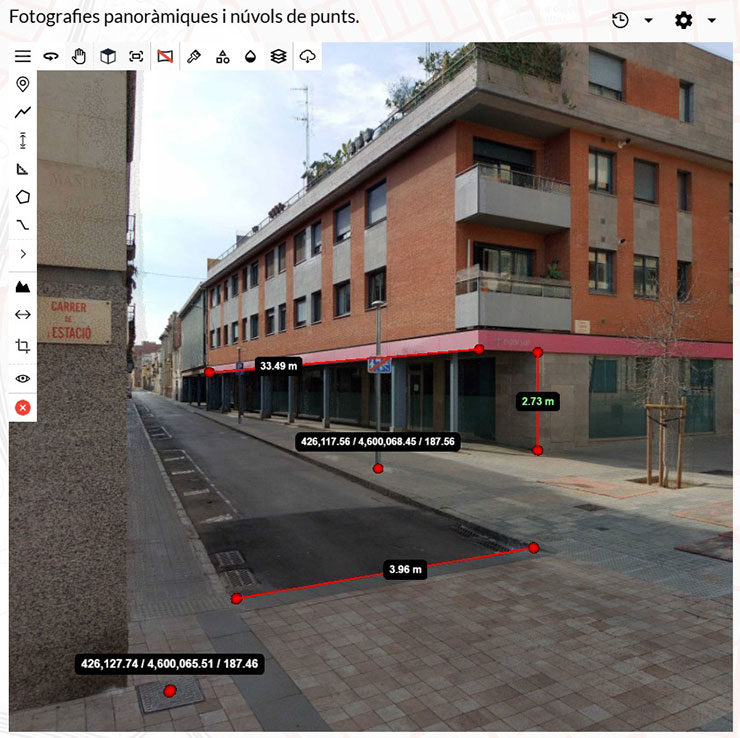
3D Measurements superimposed on the point cloud
The digital twin allows for precise analysis of the urban environment to plan improvements in mobility and infrastructure.
Sidewalk widths, building heights and distances between elements can be measured, as well as verifying alignments and space distributions.
This information is key to designing projects that guarantee accessibility, safety and efficient management of resources, reducing errors in the planning phase.
Land inspection for municipal maintenance and control
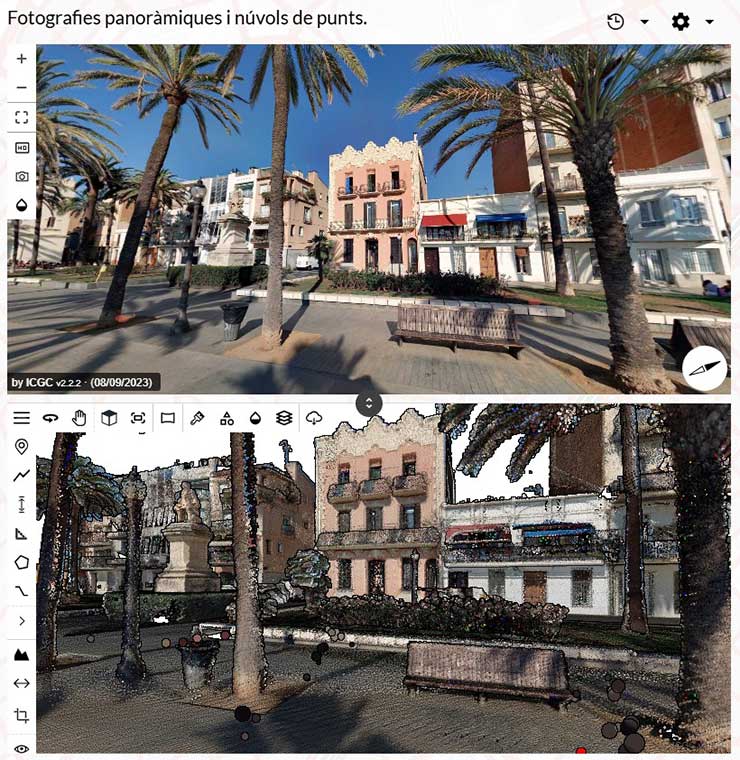
Street furniture identified with the point cloud
City councils can use the images and point clouds to inspect the condition of street furniture, sidewalks, pavements and other elements without having to physically move.
This facilitates the detection of damage, incidents and areas that require intervention.
Although complete coverage of each area is achieved in a four-year cycle, this tool is very useful for having a reliable visual basis for maintenance management and repair planning.
Cartographic validation and extraction of elements for inventories
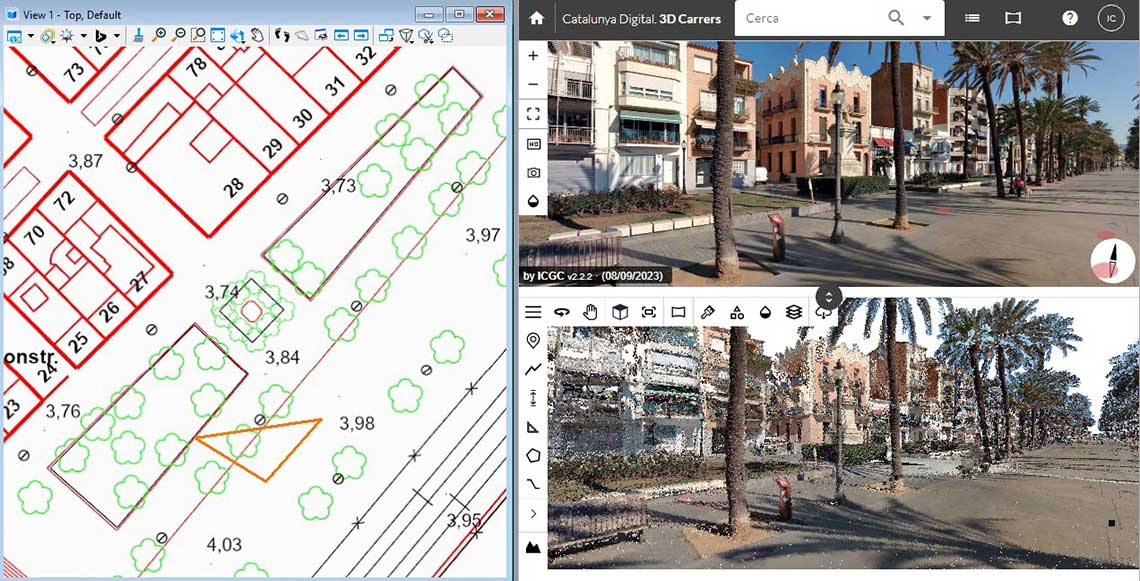
Streets 3D Viewer Interface: Location map, image and point cloud
The urban digital twin allows you to review existing cartography and validate alignments, presence of elements and coherence with reality.
In addition, the captured data is a valuable source for the extraction of elements such as street furniture, streetlights, signage, trees and other objects, facilitating the creation of inventories and the enrichment of geographic databases.
This functionality reduces costs, improves efficiency and provides detailed information for municipal management and service planning.