


Contexts favorable to the presence of critical raw materials in Catalonia
Identification of potential geological environments for minerals and critical elements
Critical raw materials, also called minerals or critical elements, are strategic materials of high economic and geopolitical value and, at the same time, are essential for the daily life of today's society.
They are essential materials for the decarbonization and electrification of the planet (solar panels, electric cars, windmills that generate electricity), and for all technological devices for both daily and industrial use (mobile phones or personal computers, air transport, spacecraft or satellites).
Currently, global control over access to this entire set of raw materials is controlled by China and Russia.
For all these reasons, the European Union has developed recommendations and regulations with the aim of promoting the study and evaluation of the presence of these raw materials within the Union:
- Promote actions to avoid dependence on third countries for the availability of these minerals: European Critical Raw Materials Act (European Commission).
- Develop roadmaps to strengthen the State's autonomy in strategic matters: Roadmap for the sustainable management of mineral raw materials (Ministry for the Ecological Transition, Spanish).
The ICGC, in the 2023-2026 program contract, within the framework of its functions, and following the regulations promoted by the European Union, is carrying out a project with the aim of identifying geological contexts favorable to the presence of critical raw materials in the territory of Catalonia.
The ICGC's activity focuses on one of its main functions, acquiring territorial geological knowledge. The objective is to have a first general vision of geological environments that are likely to generate this type of material within the framework of the geology of Catalonia. The work consists of compiling and bringing together existing geological information in scientific publications, or dispersed in universities or research centers, without carrying out fieldwork, sampling, chemical analysis or mineralogical determinations of existing samples.
The objectives of this project do not include the quantitative evaluation of resources or the determination of the degree of mineralization (essential data to evaluate resources). Nor do the objectives of the project include the evaluation of reserves or the definition or location of possible extractive areas. These last three aspects are part of the activity of other Ministries or Departments.
The project in question is structured in different geological contexts depending on the geology of the territory:
- Coastal Mountains.
- Axial Pyrenees.
- Pre-Pyrenees and the Ebro Basin.
Currently, June 2026, there are two working documents corresponding to the Catalan Coastal Mountains and the Axial Pyrenees.
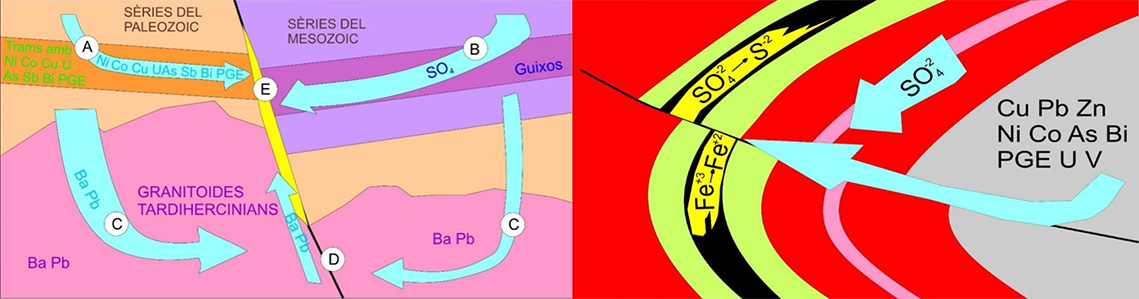
Formation models: Left) Vein by mixing fluids of meteoric origin: some wash Triassic sulfate and others, infiltrated in a deep and hotter circuit, extract Pb and Ba from the feldspars of the granites and rare metals from the metamorphic setting. Right) Eureka deposit: leaching of metals in the Paleozoic series, leaching of sulfates in the Mesozoic series and arrival of fluids in the reducing zone, where the sulfate is reduced to sulfide anion and the metals, reduced, combine with sulfur to form sulfides. Uranyl is reduced to U4+ and precipitates in the form of uraninite. Vanadium is reduced to V3+, which can enter the mica. REEs precipitate in the form of phosphates.