


La Granja d'Escarp seismic station (CGRE)
Code: CA.CGRE Name: La Granja d'Escarp Latitude: 41.3824 N Longitude: 0.3691 E Height: 405 m Local depth: 2 m Owner: Institut Cartogràfic i Geològic de Catalunya |
| Soil features | ||||
|---|---|---|---|---|
| Lithology | Period | Vs30 (m/s) | Classe EC8 | F0 (Hz) |
| Limestones, marlstones and clays | Paleogene | 745 | B | 8.5 |
| Instrumentation by channels and periods | ||||
|---|---|---|---|---|
| Channels | Start date | Sensor type | Digitizer type | Instrumental response |
| HHZ, HHN, HHE | 28/10/2025 | Very broadband velocimeter | 24 bits | [StationXML] |
Geophysical characterisation
H/V Spectral ratio from seismic noise
H/V spectral quotient of the seismic noise record at the Granja d’Escarp seismic station. A peak is observed around 8.5 Hz that can be related to the fundamental frequency of the soil and, therefore, an acoustic impedance contrast is expected in the subsoil.

Spectral quotient H/V of seismic noise from the La Granja d'Escarp seismic station
P-waves velocity model
In the Vp model, a velocity gradient is observed that goes from the surface (Vp ≈ 1000 m/s) to about 20-25 meters of depth, where velocities close to 3000 m/s are reached. On the surface, up to approximately 5 meters of depth, the velocity is less than 1500 m/s, these values are usually associated with unconsolidated materials. Around 15-20 meters of depth, velocities higher than 2500 m/s are reached, associated with sound, non-rippable rock that is usually related to the rocky basement.
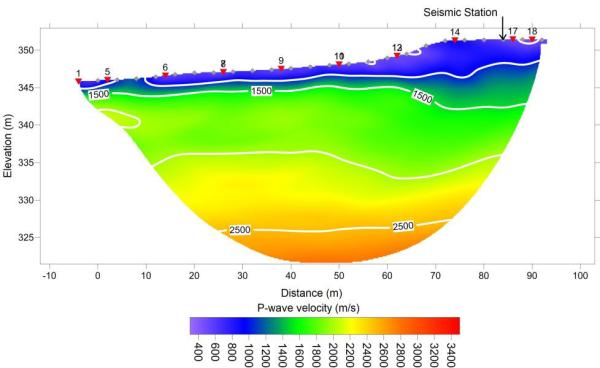
P-waves velocity model of la Granja d'Escarp seismic station
S-waves velocity model
In the shear wave propagation velocity model (Vs) obtained by the surface wave analysis (MASW), a surface layer with a velocity of about 630 m/s and a thickness of about 10-15 meters is observed. Below this layer the velocity increases to about 915 m/s. According to the Vs models, this layer can extend to more than 30 meters deep, but the depth of investigation is not high enough to have significant results at greater depths. In any case, the Vs values achieved in the models are at the limit of the thresholds used to define the bedrock (Vs ≈ 1000 m/s).

S-waves velocity model of la Granja d'Escarp seismic station obtained using the analysis of surface waves (MASW)
Electrical tomography
In the electrical resistivity model, a surface level, between 2-3 m thick, with high electrical resistivity values (> 200 Ω·m) is detected. This level is consistent with the presence of altered surface materials and with little presence of fluids. Below this surface level, an alternation of resistive and conductive sections is detected up to the maximum depth of the models (20 m). This distribution of electrical resistivity in depth correlates very well with the typical structure of this area, which consists of an alternation of soft and hard materials (alternations of clayey and calcareous levels).
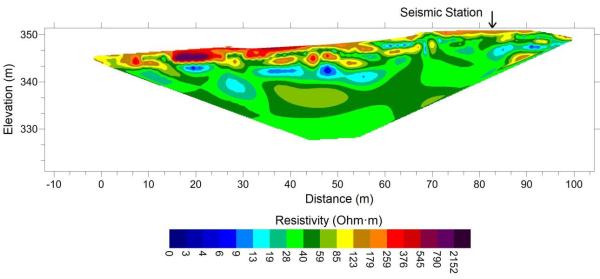
Surface electrical resistivity model with the location of la Granja d'Escarp seimic station