



Geothermal energy: learn more
The ICGC collects geothermal information and expands knowledge of the geothermal resource in Catalonia
Geothermal energy is a renewable, stable, and sustainable energy source. Its use allows for the harnessing of heat stored in the subsurface to generate electricity, heating, and cooling with minimal environmental impact. Catalonia possesses significant geothermal resources and substantial potential for development in this sector.
The origin of Earth's heat
In the late 17th century, Earth was envisioned as a molten mass with a solid crust formed as a result of cooling. It was not until the 19th century that the first calculations of Earth's age based on its thermal evolution were made, and the term "geothermal energy" was defined for the first time as the scientific discipline studying terrestrial heat—its origin, distribution, and utilization.
Earth is a hot body immersed in cold space, continuously losing temperature at a rate of 130°C per billion years. Temperatures rise from approximately 15°C at the surface to over 5,000°C at the inner core.
Volcanoes and hydrothermal systems -which give rise to high-temperature water upwellings- are the most evident manifestations of Earth's internal heat observable at the surface.
Main sources of internal heat
- Latent heat of crystallization: generated at the boundary between the liquid outer core and the solid inner core.
- Gravitational compression: the force of gravity generates internal heating.
- Residual heat: originating from the planet's initial formation.
- Internal friction: occurring between different Earth layers affected by tidal forces.
- Physicochemical reactions: mineral phase changes at high pressures and temperatures.
- Radioactive decay: of isotopes such as uranium, thorium, and potassium.

Temperature distribution within the Earth.
Geothermal gradient and heat flow
The geothermal gradient describes the increase in temperature with depth and the varying thermal conductivity of the materials through which heat passes. On average, the temperature rises by approximately 3°C for every 100 meters of depth.
Regional factors
- Active volcanism.
- Lithospheric thinning.
- Regional tectonic setting.
Local factors
- Thermal conductivity of the rocks.
- Groundwater circulation.
- Presence of fractures and faults.
- Aquifer recharge and discharge zones.
Heat flow: the amount of heat the Earth transmits toward the surface per unit of time and area. Typical continental values are around 60 mW/m².
What is a geothermal reservoir?
A geothermal reservoir is a subsurface zone where heat can be exploited both technically and economically.
It should be noted that extracting heat from the subsurface requires a fluid to transport it; furthermore, drilling to sufficient depths is necessary to reach temperatures optimal for exploitation—a process that entails costs and technical challenges that increase with depth.
Reservoirs are classified based on both fluid temperature and potential applications. Four main types of geothermal reservoirs are defined:
High temperature (>150 °C)
- Electricity generation.
- Volcanic areas or zones with high thermal gradients.
- Hot dry rock systems and geothermal reservoir stimulation.
Medium temperature (100-150 °C)
- Electricity generation with moderate efficiency.
- District heating networks.
- Industrial applications.
Low temperature (30-100 °C)
- District heating.
- Industrial processes.
- Deep thermal water.
Very low temperature (<30 °C)
- Very low temperature (<30 °C)
- Geothermal heat pumps.
- Residential climate control.
- Virtually universal application.
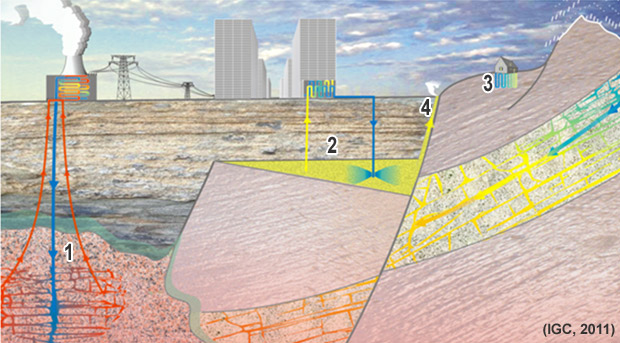
Examples of geothermal resource exploitation:
- High-temperature: Cold water is injected into a deep granitic basement underlying a sedimentary cover (a geological arrangement where the contrast in thermal conductivity enhances the geothermal gradient) and extracted at high temperatures; upon contact with a secondary surface circuit, steam is generated to produce electricity.
- Medium-temperature: Hot water is extracted from a deep aquifer to exchange heat with an urban district heating system and is subsequently reinjected.
- Low-temperature: A buried heat exchanger harnesses the ground's thermal inertia—which provides a stable temperature—to provide climate control for a home in both winter and summe.
- Also depicted is a natural thermal spring resulting from a water circulation process: infiltration in a recharge zone, slow movement through a deep aquifer, and rapid discharge via a permeable fault.
Geothermal energy
Geothermal energy is energy obtained from the Earth's internal heat. It is considered a renewable source because the planet cools extremely slowly.
Advantages
- Low CO₂ emissions.
- Continuous 24/7 production.
- Renewable resource.
- Minimal visual impact.
- High energy efficiency.
Main applications
- Electricity generation.
- District heating.
- Building cooling and climate control.
- Greenhouses.
- Fish farms.
- Spas and thermal waters.
- Industrial processes.
Geotèrmia a Catalunya
Catalonia has a long history of geothermal research, particularly dating back to the 1970s and 1980s. The study of geothermal energy in Catalonia and Spain was the subject of numerous projects and investments during the 1980s, in the wake of the oil crisis. The Geological and Mining Institute of Spain (IGME) produced the National Inventory of Geothermal Manifestations (1976), and various surveys of thermal sites were conducted in Catalonia.
Growing interest in Catalonia's potential geothermal areas led the IGME to launch studies in the Vallès zone (between Sentmenat and Samalús), where thermal springs emerged at temperatures ranging from 60°C (la Garriga) to 70°C (Caldes de Montbui). The geological structure of the Vallès area—featuring the western Vallès fault and the pre-coastal granitic thrust—marked the region as a promising site for a geothermal resource. Vallès Occidental was designated a Geothermal Reserve, and the first geothermal exploration well was drilled in Samalús (1981).
The Olot and La Selva depressions were also identified as areas of interest and, together with the Empordà region, were consolidated into the Olot Geothermal Reserve. The Sant Cugat area attracted interest, and the company ENHER, in collaboration with the IGME, conducted a detailed study of the Sant Cugat geothermal anomaly, involving the drilling of a piezometric monitoring well (1983) and a production well (1984).
In the early 1990s, coinciding with a drop in oil prices, studies on geothermal energy were abandoned.
Currently, geothermal energy remains relatively unknown and under-considered in Catalonia; however, with the recent boom in renewable energy, it is once again a subject of study, and its application in building climate control systems is expanding rapidly. The Government of Catalonia promotes its use in homes and public facilities—including iconic examples such as the Mollet Hospital, which uses geothermal heat pumps for climate control.
As of February 2024, there are 128 geothermal installations promoted by the public sector.
Areas of geothermal interest
- Caldes de Montbui.
- La Garriga.
- Samalús.
- Sant Cugat del Vallès.
- Olot.
- La Selva.
- Empordà.
Role of the ICGC
- Preparation of the Geothermal Atlas of Catalonia.
- Compilation of geothermal data.
- Production of geothermal thematic mapping.
- Support for energy planning.
- Promotion of knowledge regarding geothermal resources.
Organizations and resources
Organisms
ICAEN, Institut Català d'Energia
Energia, mines i seguretat industrial, Departament d'Empresa i Coneixement
IDAE, Instituto para la diversificación y ahorro de la energía
European Comission Energy: http://ec.europa.eu/energy/index_en.htm
Geothermal Energy Association (GEA): http://www.geo-energy.org/
Geothermal Education Office (GEO): http://geothermal.marin.org/
European Geothermal Energy Council (EGEC): https://www.egec.org/
International Geothermal Association: http://www.geothermal-energy.org/
Projects and dissemination
Clúster de l'Energia Eficient de Catalunya. Grup de Treball de Geotèrmia (GTG). Project presentation meeting. Assembly Hall, ICGC. September 28, 2018.
Exhibition "Energia geotèrmica: Una aposta de futur sostenible". 17a edició de la Setmana de la Ciència, 2012. CST Pirineus, Tremp (includes the exhibition brochure and posters)
Fundación de la Energía de la Comunidad de Madrid (FENERCOM): https://www.fenercom.com
European Geothermal Energy Council (EGEC): https://www.egec.org/
Plataforma tecnològica espanyola de geotèrmia (GEOPLAT): http://www.geoplat.org
GeoVic - Explore Victoria online: http://earthresources.vic.gov.au/earth-resources/maps-reports-and-data/geovic
Island Dam and Geothermal Impact Map: http://mappery.com/map-of/Iceland-Dam-and-Geothermal-Impact-Map
ThermoGIS: https://www.thermogis.nl