


Coastal-derived thematic elevation models
High‑resolution coastal slope orientation models of Catalonia
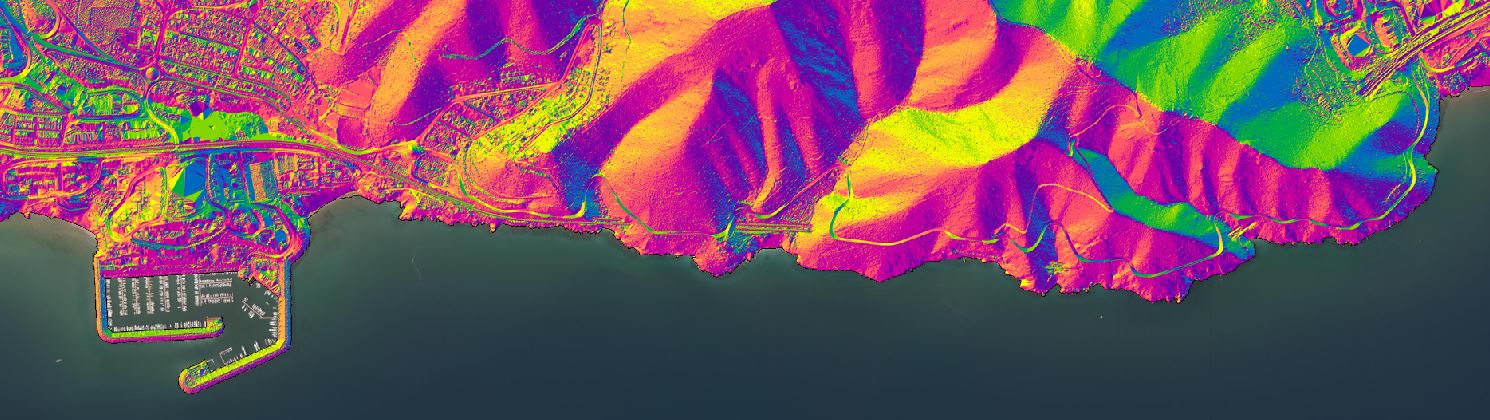
The ICGC provides the Slope Orientation Model, which indicates the slope direction at each point of the terrain and covers the coastal strip up to 500 m from the shoreline with a resolution of 50 cm. It is calculated from the DTM using gradients and angles relative to the north, assigning values between 0° and 360°. With periodic updates and historical data dating back to 2008, it enables detailed studies and long-term trend monitoring.

| Geoinformation from the Cartographic and Geological Institute of Catalonia subject to a Creative Commons Attribution 4.0 International license (CC BY 4.0). More information |
Last update
- Publication date: March 2026.
- Information date: 2014, 2015, 2016, 2017, 2022, 2023 and 2024.
- Version: v1.0.
Description
The ICGC provides the Slope Orientation Model, a product derived from the Digital Terrain Model (DTM) that indicates the slope direction at every point of the terrain. This model is especially useful for geomorphological studies, coastal dynamics analysis, and territorial planning, as it provides insight into how slopes are distributed and where the natural flow of water is directed. Since 2022, two annual flights are carried out, with additional flights after coastal storms, ensuring constant updates. The product is complemented with historical data dating back to 2014, creating an extensive time series for analysing trends and validating predictive models.
The Slope Orientation Model is obtained from the Digital Terrain Model (DTM), which represents the bare-earth surface. Based on this DTM, the slope orientation (also known as aspect) is calculated for each cell, indicating the cardinal direction toward which the terrain is inclined.
The process consists of:
- Gradient derivation: the slope is calculated in the X and Y directions using finite difference methods on the regular DTM grid.
- Orientation angle calculation: based on the gradients, the angle in degrees relative to geographic north is determined and converted into a cardinal direction (N, NE, E, SE, etc.).
- Cell value assignment: each pixel of the model receives an orientation value between 0° and 360°, where 0° corresponds to north, 90° to east, 180° to south, and 270° to west.
Once the slope orientation model is obtained, the slope orientation map is generated using a legend that assigns an RGB colour to each orientation value range.
This model is especially useful for analysing natural drainage dynamics, identifying water accumulation areas, studying erosion processes, and guiding environmental restoration strategies. The 50 cm per-pixel resolution and the availability of updated data from two annual flights ensure precise and temporally rich information for scientific studies and territorial planning.
Main technical characteristics
- Product: Representation of slope orientation relative to geographic north.
- Coverage: Coastal strip of Catalonia up to 500 m from the shoreline.
- Data source: LiDAR point cloud captured in periodic flights over the Catalonia coastline.
- Resolution: 0.5 m pixel in models from 2021 onwards and 1 m pixel in historical models.
- Reference system: EPSG: 25831.
- Format: GeoTIFF (raster). Null values: -9999.
- Update frequency: Twice a year (winter and autumn), plus specific flights after coastal storms, and historical data.
Use cases
Coastal biodiversity and ecology studies
The Slope Orientation Model is essential for understanding how slope direction influences environmental conditions on the coastline. Orientation determines solar exposure, temperature and humidity, factors that condition the distribution of plant and animal species. For example, south-facing slopes receive more hours of sunlight, favouring vegetation communities adapted to drier conditions, while north-facing orientations retain more moisture and are ideal for shade-tolerant species. This information is also key for studying dune habitat dynamics, vegetation recovery after storms, and the presence of species sensitive to microclimate variations. In addition, it supports conservation planning, environmental restoration, and climate change impact assessment on coastal biodiversity.
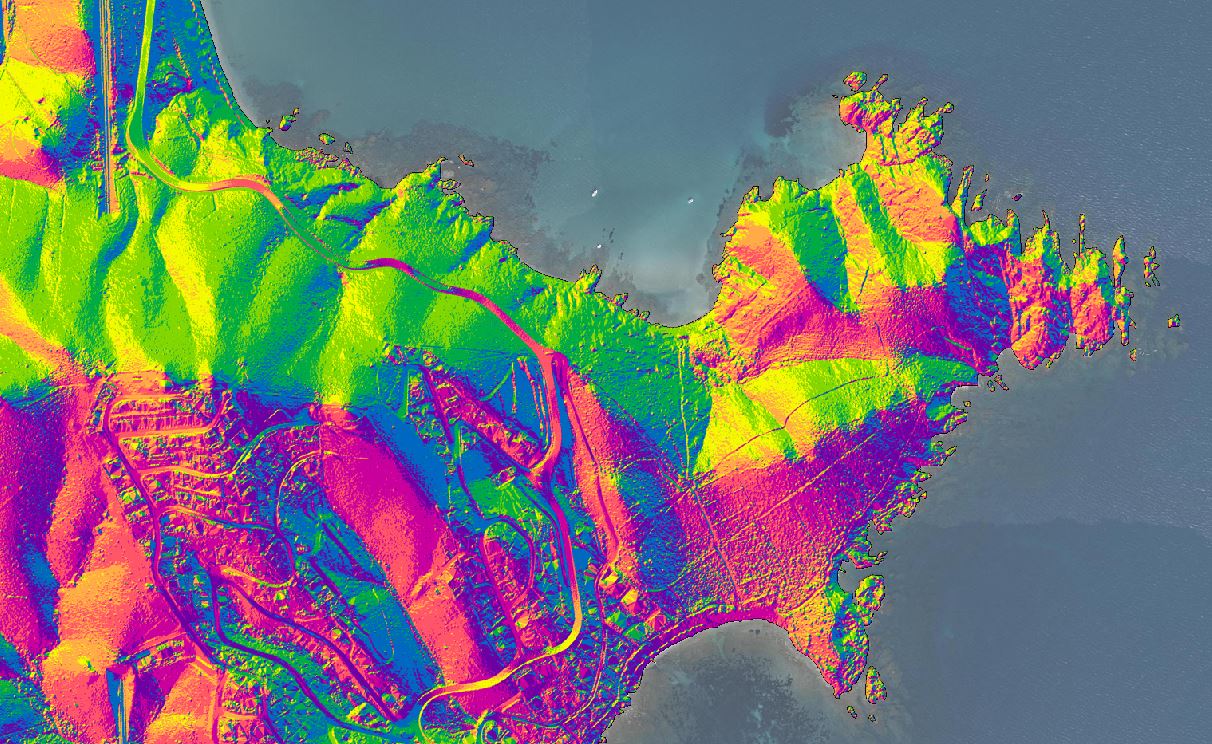
Cap Ras, Autumn 2022
Drainage management and flood control
Slope orientation is crucial for understanding where natural water flow is directed. This model makes it possible to identify accumulation areas, plan drainage systems, and design infrastructure that minimises flood risk in coastal zones. It is also useful for simulating storm impact scenarios and defining preventive measures.
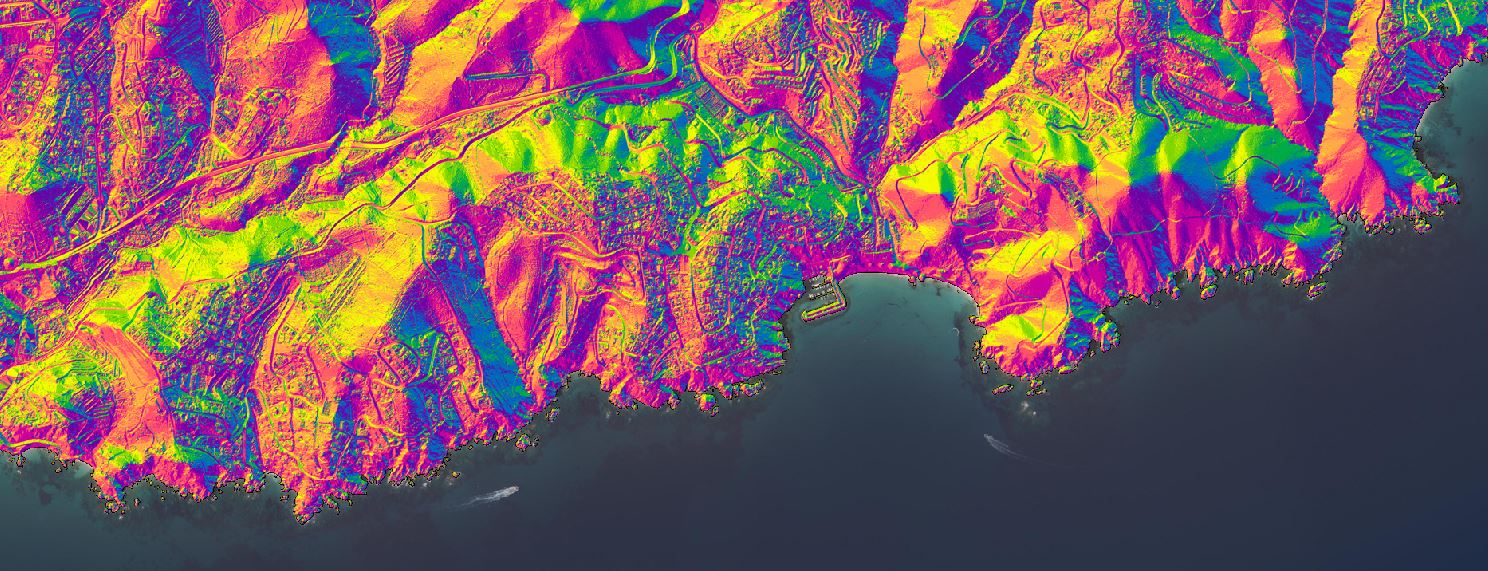
Canyelles, Autumn 2022