


Roquetes seismic station (EROQ)
Code: EROQ Name: Roquetes Latitude: 40.8232 N Longitude: 0.4088 E Height: 284 m Local depth: 0 m Owner: Ebre Observatory |
| Soil features | ||||
|---|---|---|---|---|
| Lithology | Period | Vs30 (m/s) | Classe EC8 | F0 (Hz) |
| Detrital matherials and calcarenites | Upper Tertiary | 1024 | A | - |
| Instrumentation by channels and periods | |||||
|---|---|---|---|---|---|
| Channels | Start date | Sensor type | Digitizer type | Instrumental response | |
| SHZ | 12/02/1987 | 01/11/2003 | Short period | - | - |
| SHE, SHN | 06/11/1991 | 01/11/2003 | Short period | - | - |
| HHZ, HHN, HHE | 19/01/2023 | - | Broadband velocimeter | 24 bits | [StationXML] |
The Roquetes seismic station (EROQ) was installed on February 12, 1987 by the National Geographic Institute (IGN) as part of the "National Seismic Network". It is located several kilometers apart of the old EBR seismic station. Collaboration between the Observatori de l'Ebre (OE) and the Servei Geològic de Catalunya (SGC) allowed several subsequent improvements until November 1, 2003 when the station was definitively shut down.
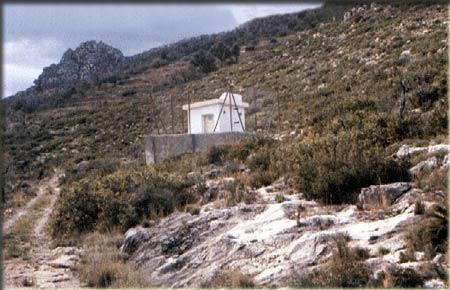
Roquetes Seismic Station (EROQ)
Geophysical characterization
H/V spectral ratio of seismic noise
A practically flat curve is observed, without any significant peak that can be related to the fundamental frequency of the ground, typical of locations on bedrock.
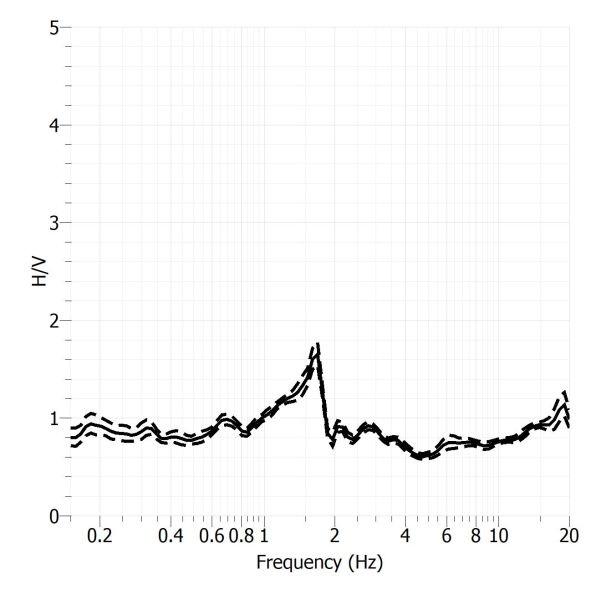
H/V Spectral ratio of seismic noise records from Roquetes seismic station.
P-wave velocity model
The P-wave velocity model (Vp) obtained by seismic refraction tomography is characterized by the presence of high-speed materials, even at the surface. At the maximum depth of investigation of the model, just over 15 meters, 5000 m/s are exceeded. In the sector near the seismic station, velocities higher than 3000 m/s are reached at a depth of about 2 meters. These velocity values are associated with sound, non-rippable rock and can be interpreted as bedrock.
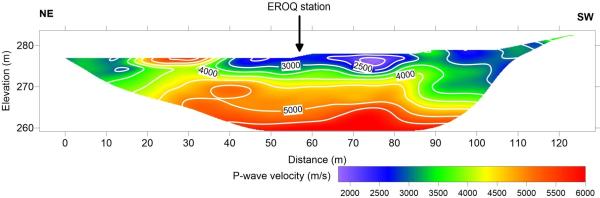
P-wave velocity model of Roquetes seismic station.
S-wave velocity model
The shear wave propagation velocity model (Vs) obtained by the analysis of surface waves (MASW) is characterized by a surface layer, between 1 and 2 meters deep, of low velocity (195 m/s). Below this is a high velocity layer (1200 m/s) that extends to the end of the model. This last layer can be interpreted as the bedrock.
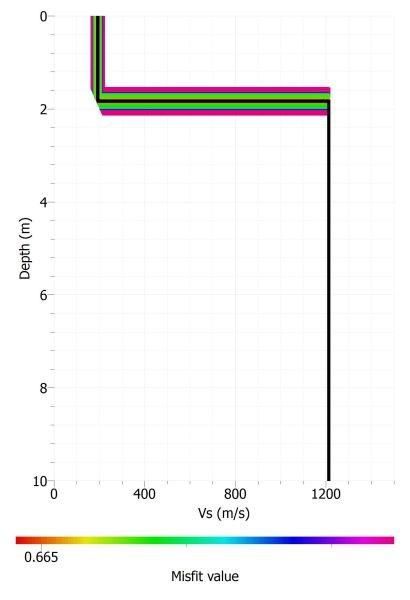
S-wave velocity model of Roquetes seismic station.
Examples of seismograms from the EROQ seismic station
The waveforms from this seismic station were recorded on thermal paper at the OE. Thanks to the collaboration between the OE and the ICGC, the entire series of thermal paper recordings of this station, preserved in the OE, have been scanned, in grayscale and with a density of 1200dpi.

Seismic record of Roquetes (EROQ) analog seismic station for 20-21 May 1992. A record of a teleseism is observed at the top and at the bottom the record of a nuclear explosion in China.

Seismic record of Roquetes (EROQ) analog seismic station for 20-21 May 1992. A record of a teleseism is observed at the top and at the bottom the record of a nuclear explosion in China.

Seismic record of Roquetes (EROQ) analog seismic station for 20-21 May 1988. A swarm of earthquakes ocurred near la Seu d'Urgell is observed.