


Passive seismic
Seismic noise acquisition and analysis
Passive seismic surveys are based on acquiring seismic noise with different sensor arrays and during a specific time window. These techniques do not require an active seismic source (such as a hammer or explosives). Seismic noise is defined as ground motion generated by non-seismic sources, such as ocean waves propagating over long distances, sea waves on nearby coasts, wind, and sources related to human activity (traffic, heavy machinery, etc.). Seismic noise is characterized by low amplitude and a wide frequency range.
Methodology
The passive seismic surveys techniques used by the Cartographic and Geological Institute of Catalonia are the H/V spectral ratio technique for seismic noise and the array technique. The H/V spectral ratio technique is based on recording seismic noise with a single 3-component seismometer, from which the fundamental frequency of the ground is obtained. The array technique records seismic noise using a constellation of sensors and characterizes the vertical profile of the shear wave propagation velocity. Combining these two techniques allows for the determination of sediment thickness (Quaternary and/or Neogene).

Seismic noise measurement with the H/V spectral quotient technique.

Example of the H/V spectral ratios obtained in soil (top) and rock (bottom) locations. The spectral quotients for each calculation window are represented in color, and the black line represents the average of all windows together with their error bands (dashed).
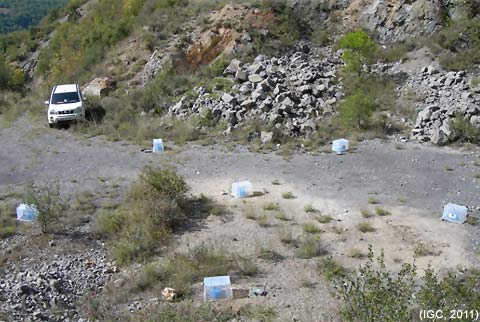
Overview of seismic noise measurement with the array technique

Model of the vertical profile of shear wave propagation velocity, obtained with the array technique.
Applications
An important area of application for these techniques is urban areas, thanks to their zero environmental impact and their rapid implementation. Their use extends to the fields of seismic engineering, civil engineering, geotechnics and urban geology.