


We are taking part in the SOLPYR II project to improve knowledge and protection of Pyrenean soils
We are taking part in the cross-border SOLPYR II project (Pyrenean Soils: a Heritage to Preserve through Responsible Management), which aims to deepen knowledge of Pyrenean soils, study their vulnerability to the effects of climate change, and promote their conservation and sustainable management.
In this new phase, we are coordinating the action dedicated to information on Pyrenean soils. This includes expanding the soil catalogue and developing a common methodology to assess soil health. We are also taking part in the project's awareness-raising and governance activities.
Background and continuation of the SOLPYR project
SOLPYR II builds on the SOLPYR project, launched in 2024, which laid the foundations for improving knowledge and protection of Pyrenean soils through four areas of work: soil information, vulnerability analysis, raising awareness among mountain users, and governance.
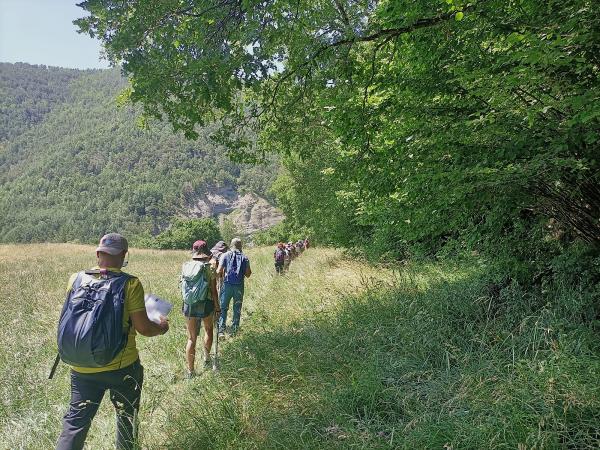
Survey of one of the soil itineraries developed as part of the SOLPYR project in the Sobrarbe Geopark.
During this first phase, several initiatives were developed, including harmonised soil classification mapping at a scale of 1:400,000, eight soil science trails, educational materials, and citizen science activities related to erosion processes.
SOLPYR II aims to build on these results and move towards more responsible soil management by strengthening cooperation among the different stakeholders across the Pyrenean region.
Our role in SOLPYR II
In this second phase, we are coordinating the soil information action, which includes expanding the Pyrenean soil catalogue and harmonising data and characterisation methodologies. We will also work on producing detailed soil maps for a pilot area in Cerdanya, at a scale of 1:25,000.
As part of the project, we are also involved in developing educational materials and resources, a travelling exhibition on Pyrenean soils, and governance activities within the Pyrenean Soil Alliance (ASPir).
This joint effort will provide more information on mountain soils and improve the tools needed to understand their condition, identify their vulnerabilities, and guide their management.
Vulnerability and conservation of Pyrenean soils
Soils are a fundamental natural resource for the functioning of ecosystems. They play a role in regulating the water cycle, storing carbon, and preserving biodiversity. However, they are particularly vulnerable to degradation processes such as erosion, compaction, and the loss of organic matter.
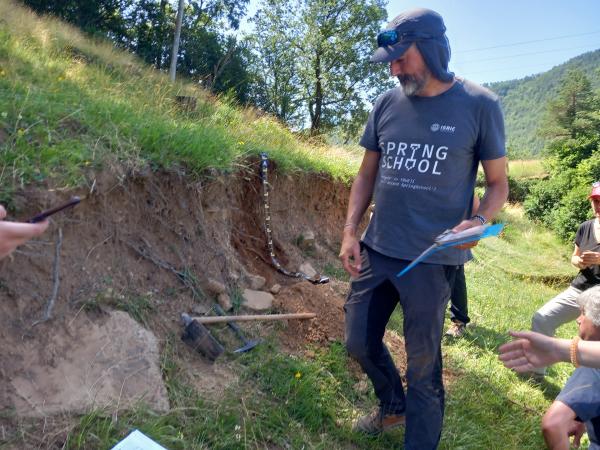
Project experts carrying out the description of a soil profile.
In the Pyrenees, these processes may be exacerbated by climate change and human activities such as livestock farming, agriculture, forest management, and tourism.
For this reason, SOLPYR II will also work in six pilot areas to study changes in erosion and soil organic carbon content, as well as the effects of different agricultural, livestock farming, and forestry practices. The project also plans to produce a technical guide to good practices for mountain soil conservation, develop educational tools, and promote awareness-raising and citizen science activities.
Project partners and funding
SOLPYR II is coordinated by the Université de Toulouse and involves eleven organisations from Catalonia, the Basque Country, Navarre, Aragon, Andorra, and France: FORESPIR, ICGC, NEIKER, the Pyrenean Institute of Ecology (IPE-CSIC), the Pyrenean Climate Change Observatory (OPCC-CTP), the Université de Pau et des Pays de l'Adour (UPPA), the Public University of Navarre (UPNA), Réseau Éducation Pyrénées Vivantes (REPV), Fundació Marcel Chevalier (FMC), the Department of Rural Development and Environment of the Government of Navarre (DRYMA), and Université de Toulouse itself.
The project will run until May 2029 and has a total budget of €1,852,348. It is co-funded at 65% by the European Union through the Interreg POCTEFA 2021–2027 programme, which promotes cooperation between Spain, France, and Andorra.
Through our participation in SOLPYR II, we continue working to expand knowledge of Pyrenean soils and contribute to their protection, in collaboration with organisations and stakeholders across the region.
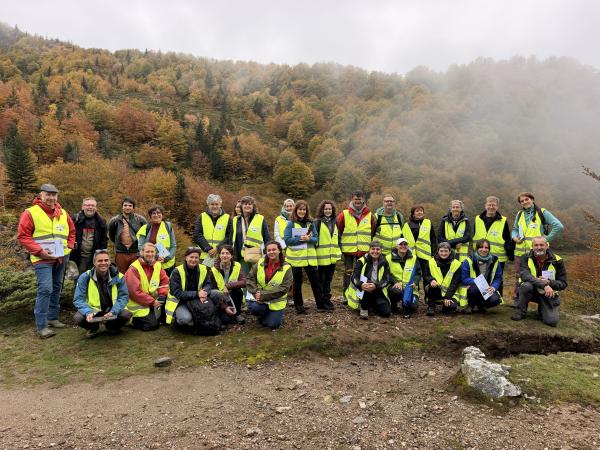
Participants of the SOLPYR and SOLPYR II project at the Parc Naturel régional des Pyrénées Ariégeoises.
More information: SOLPYR II